The Surgery Rotation
by Hersh
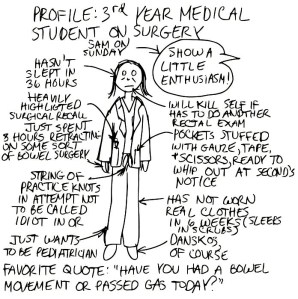 I started writing this post 6 weeks ago and I intended to focus on describing the art of retraction. Retraction, in surgical terms, is the technique of pulling apart the skin and soft tissue in an open cavity (the surgical field) so that the operating surgeons have free hands for delicate movements within. As a third year medical student rotating through surgery, retraction is 80% of my daily clinical duty. However, this post quickly devolved into a catharsis on my experience as a medical student on my surgery rotation. It’s a small part of what I’ve done, but it’s the part most worth sharing. Enjoy.
A Meditation in Masochism
First, let me welcome you into the OR. In the center of the room lies your patient, strapped to an operating table and draped in sterile blue sheets. Just beyond the head of the table is the Wonderland of Anesthesia. It’s a “non-sterile” area cluttered with anesthesia equipment (vents, gasses, monitors, etc), and it’s usually obscured by blue drapes clipped high enough to keep the anesthesiologist’s (or his/her nurse anesthetist’s) Candy Crush game out of view of the surgeons. At the foot of the table is the Zone of Pure Sterility (aka the Mayo Tray) governed by the surgical scrub technician. This person’s job is to handle all instruments/materials and ensure above all things that the surgical field remains sterile. Mostly, this means they watch over us students in the way a shepherd watches his flock – quick to the switch, but for your own good. Swarming all around the room are usually 1-2 nurses (called circulator or OR nurses) whose responsibilities are to be the Johnny-on-the-spot for delivering any supplies from the general OR area into the Zone of Pure Sterility. Finally, packed in between the foot and head of the bed and snuggled up to the patient’s body on either side are the surgeon, the resident, the medical student, and the scrub tech. You can imagaine how cozy it gets.
Next, let’s review standard surgical garb and the process of scrubbing in. “Scrubbing-in” is the proper washing-up and gowning technique designed to maintain the utmost level of sterility around a surgical field. It starts with a three-way tango between the attending (surgeon), the resident (surgeon-in-training), and the student in the scrub room outside the OR. After putting on your cap, mask, and face shield and securing all your pockets, you grab some industrial-strength soap and start lathering and scrubbing. The unspoken rule during this washing-up period is that the younger you are, the longer you wash. This means the student starts washing before the resident, who starts washing before the attending, and they finish in reverse order. At this point, your hands are completely sterile, so you hurry over to the Mayo Tray, climb into your gown, slip on two layers of sterile gloves, and settle into your position at the table. So begins the agony.
It always starts 15-20 minutes into the case, when you’ve had a chance to get over the initial excitement of cutting, cauterizing, etc. Then, the attending hands you some retractors while she searches for bleeding vessels to ligate or lymph nodes to remove, and you’re expected to hold tension like a statue. This is doable for a couple of minutes, but your arms or fingers inevitably fatigue and you start to get that burning sensation like your body is screaming for you to give it a break. But you hold on like a statue. How does your body soothe that burning sensation? With sweat. Generous amounts of slow-beading, gentle-rolling, teasing sweat. You feel the beads under your armpits, and that’s ok. You feel it down your spine, and that’s uncomfortable, but its ok. Then you feel a bead or two start forming on your forehead, and that’s not ok. If you’re lucky, those beads on your forehead will roll down your temple and maybe settle into your cheek. If you’re unlucky, they’ll trickle through your eyebrows and start mixing in with your blinks, and now you have real problems. Every natural instinct your body possess will compel you to rub your eyes to clear the stinging, yet every rule of surgical sterility precludes you both from releasing tension on your retraction and from touching above your nipple line with your gloved hand. Your only option is to wait it out and hope you produce enough tears to wash away the sweat.
If you’ve made it through the initial phase of muscle fatigue and sweating, you’ll hit a nice, sweet homeostasis where your body comes to terms with the stress it’s under. But don’t get comfortable because here comes an itch. You’ll never truly learn the character of an itch until you’re physically unable to scratch it. I learned that itches can be painful, electric, numbing, warm, or a number of other flavors. And I also learned that they’re temporary. Unlike the sweating, you can usually “will yourself” out of an itch, but this takes time and practice. Oh, you’ve succeeded in conquering the itch? Here comes a random, shooting, stabbing pain from a muscle spasm because you’ve been retracting with 50 ft-lbs of static force for over an hour. DON’T TWITCH! The attending is now on a tense hunt for that last, buried lymph node and losing visualization of the field could set us all back! DON’T TWITCH! The small bleeder deep in the axilla is in clear view and moving around now could spell disaster for the patient! DON’T. TWITCH.
Good, you’re hitting a groove now. You’re in hour 3 or 4 and you’re zen. But now the blood isn’t circulating through your lower extremities very well, because you haven’t moved your feet since we started. Your feet aren’t happy about this, and they start to express their disapproval. They moan and they ache and they send little creeping cramps up through your ankles and calves. Sure you can pick them up and wiggle them around a bit to shake off that cramp, but that’s just temporary relief. All they want is to have you sit down, kick them up onto a table, and let them drain all that collected blood and edema and metabolic waste settled down in there. They just want a break. Every part of your body wants a break.
Maybe you’re conditioned. Maybe none of this matters to you because your body is your temple and you’ve been training for surgery since you ran your first marathon. If that’s the case, none of the above applies to you because your body is incapable of fatigue. But what about your mind? What about your emotions? This surgery you’re in today is the 4th one on the list and you’ve been up since 4:30AM and you’re running on 8 hours of sleep in the last three days and all you’ve had this morning is an apple and a RedBull. You’re mentally exhausted and you’re unable to maintain focus for longer than 45 seconds at a time. Plus, maybe your eyelids are getting heavy. That’s ok, right? All you’re doing is retracting, right? Mindless physical labor?
“Student! While I’m exploring the axillae for Level II and III nodes, why don’t you remind us all of the anatomical borders of this dissection and the delicate neurovascular structures contained herein?”
Silence.
“Student doctor!”
Your mind jars awake and all that sweat you kept at bay comes gushing back with the sympathetic response generated from the fear and panic you’re feeling. You only heard half the question and your mind was on your lunch. You’ve already been prompted twice, so the next words out of your mouth better be the right answer.
“Uh, well…the borders are…”
You’re either ready or you aren’t. This is make-or-break. If you get it right, expect more questions until you get one wrong. If you get it wrong, expect a cold, gut-wrenching expression of disappointment that’s some variation of, “You need to read up on the topic.”
Regardless of the outcome, you’re back at square one. You’re out of your zen, you’re sweating, your heart is pounding, and your mind is tearing itself apart with self-doubt and loathing. You’re repeating to yourself the words you knew deep down but failed to say when it mattered. You’re angry at the attending for not congratulating you on what you answered correctly. You’re angry at yourself for not studying, you’re angry at the rotation for not allowing you more time to study, you’re angry at your body for failing you, and you’re just done with the whole thing. Co-incidentally, this is when the case ends.
You tear off your scrubs and suddenly, there’s no itch to scratch or sweat to wipe. There’s no sense of fatigue. You’re sore, but the overwhelming relief of being liberated from the sterile field make you feel invincible. You walk out of the OR, reach out for a good, long stretch, and walk over to the board to see where you need to be next. There’s no time for lunch. There’s no room for self-pity or feeling defeated. You’re a student on your surgery rotation. You’re eager to please and ready for more.
 Hersh Varma